




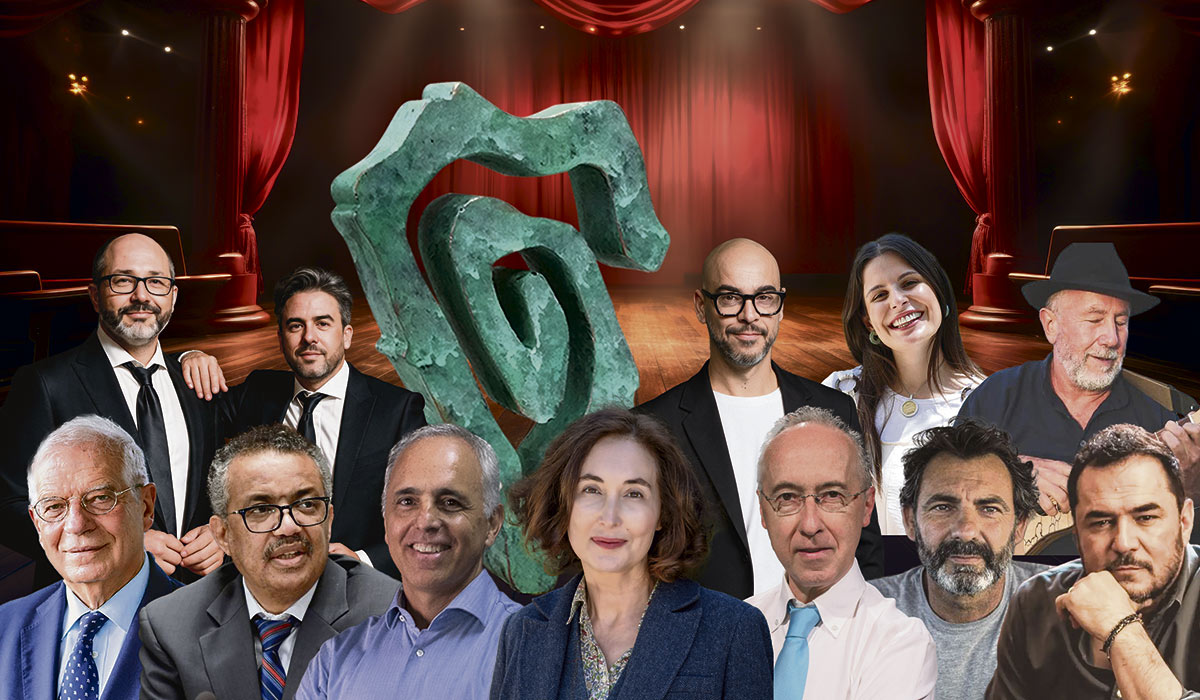
The Taburiente Awards return this year for their 11th edition, consolidating a journey that has turned them into one of the DIARIO DE AVISOS Foundation’s most recognisable platforms for honouring talent, dedication and social commitment.
Since their creation, the awards have sought to recognise people and organisations whose work goes beyond their own field and leaves a mark on society. Over more than a decade, they have highlighted careers linked to culture, journalism, humanitarian action, healthcare, politics, business, music, public outreach and the arts.
The 2026 edition once again reflects that broad and diverse spirit. The list of award winners brings together international public figures, artists, activists, communicators, business leaders and cultural projects. What unites them is not a single profession, but the ability to transform their environment, defend necessary causes, open new paths and turn a personal or collective vocation into a reference for others.
This wide-ranging character has become one of the defining features of the Taburiente Awards. The honours look both to the Canary Islands and to the wider world, recognising excellence, creativity, innovation, human rights, social responsibility and the courage to respond to some of the great challenges of the present.
On 29 October, the Teatro Leal in San Cristóbal de La Laguna will once again become the meeting place for these stories. The gala will bring together emotion, gratitude and public recognition in a ceremony designed to celebrate not only achievements, but also the meaning and impact behind each career.
The event will be broadcast by Atlántico Televisión, the official broadcaster of the DIARIO DE AVISOS Foundation’s events. The channel will bring viewers a new edition of an awards ceremony that continues to grow while preserving its original purpose: to recognise those who, from different backgrounds and disciplines, contribute through their work to improving and transforming society.
Open Arms – Special Mention

A single image was enough to turn shock into action.
In September 2015, the photograph of little Alan Kurdi, a Syrian boy of just three who drowned while trying to reach the Greek island of Kos with his family, moved the world. It also led the entrepreneur and maritime rescue professional Óscar Camps to travel to Lesbos with a small group of volunteers.
They arrived with 15,000 euros of their own money and a clear mission: to save lives at sea.
That first journey marked the beginning of Open Arms. Within a few months, thousands of people were rescued off the Greek coast. As migration routes shifted and the central Mediterranean became one of the deadliest passages in the world, the organisation expanded its work.
What began as an emergency response became a humanitarian organisation dedicated to assisting people forced to make extreme journeys while fleeing war, persecution, poverty and despair.
Since then, Open Arms rescue teams have operated aboard vessels such as the Astral and the Open Arms, offering help in situations where the sea becomes both a route of hope and a place of danger. In 2025, as the organisation marked its tenth anniversary, Open Arms put the number of lives saved at sea at more than 73,000.
The Canary Islands have also formed part of this story. In 2016, Open Arms received the Canary Islands Gold Medal. In 2025, the organisation deployed its vessel for two months across the archipelago to raise awareness of the reality of the Atlantic migration route.
Óscar Camps has led this commitment from the beginning, guided by the conviction that when a life is at risk, indifference is not an option.
After a decade of work, Open Arms continues to sail where the sea has become a border. Its story is built on a decision that has remained unchanged: never to look the other way.
Tedros Adhanom Ghebreyesus

The defence of healthcare as a universal right has shaped the career of Tedros Adhanom Ghebreyesus.
That conviction began early in life, through a family experience that revealed in the harshest possible way the consequences of not having access to adequate healthcare. The loss of one of his younger brothers, probably to a disease preventable by vaccination, marked his understanding of health not as a privilege, but as a right.
Born in Asmara, in present-day Eritrea, Tedros trained in biology, immunology of infectious diseases and community health. His early professional work focused on combating malaria, a field that would later connect with his broader commitment to public health and health systems.
As Ethiopia’s Minister of Health, he led a far-reaching reform designed to bring healthcare to remote areas and make access to medical services more equitable.
In 2017, he became the first African to head the World Health Organisation. Re-elected in 2022, he led the WHO through the COVID-19 pandemic and other major international emergencies.
Throughout that period, he defended universal health coverage and insisted that refugees and migrants should also be included in the right to healthcare.
His commitment also had a direct connection with the Canary Islands. In May 2026, he travelled to Tenerife during the international response to the hantavirus outbreak on board the MV Hondius. During that visit, he highlighted the solidarity and humanity shown by the island.
From public health to international diplomacy, Tedros has maintained a consistent focus on placing people at the centre of decision-making and defending health as a truly universal right, regardless of origin or circumstance.
Josep Borrell

Josep Borrell was born in 1947 in La Pobla de Segur, a small village in the Catalan Pyrenees, into a family of bakers.
He completed part of his secondary education at home while helping in the family bakery. Over time, study became one of the great tools of his life. He trained as an aeronautical engineer, mathematician and economist, and later earned a PhD in Economic Sciences.
That intellectual foundation accompanied a long career devoted to public service.
For more than four decades, Borrell has held some of the highest responsibilities in Spanish and European politics. He has served as Secretary of State, Minister for Public Works, President of the European Parliament, Minister for Foreign Affairs and, finally, as High Representative of the European Union for Foreign Affairs and Security Policy and Vice-President of the European Commission.
In that last role, he represented European diplomacy during especially turbulent years, marked by the war in Ukraine, the crisis in the Middle East and deep geopolitical tensions.
During that period, he defended a clear conviction: that Europe is not merely a geographical space, but a shared political project, a voice that must be present in the world and a set of values worth defending.
Today, as President of CIDOB, the Barcelona Centre for International Affairs, he continues to reflect on international relations and the major challenges facing an increasingly complex and uncertain world.
From a family bakery in the Pyrenees to the main European institutions, Borrell’s path has been marked by study, convictions, public service and the defence of the European project.
Elsa Punset

Understanding how the mind works, how emotions shape us and how relationships influence our lives can change the way we live. This idea runs through the work of Elsa Punset.
As a writer, philosopher and science communicator, Punset has spent more than two decades building bridges between scientific knowledge and everyday life.
Her work is defined by a clear, accessible and deeply humanistic approach. She has helped turn complex ideas about the brain, emotions, fear, uncertainty and relationships into practical tools for daily life.
At a time when emotional intelligence was not yet part of mainstream public conversation, Elsa Punset became one of the voices that helped bring the concept closer to society.
Her books, lectures and media work have reached millions of people. Works such as A Compass for Emotional Navigators, A Rucksack for the Universe, The Book of Small Revolutions and Wings to Fly form part of a body of work dedicated to understanding who we are, how we relate to others and how we can live with greater awareness and freedom.
In 2025, she created the Punset Terraviva Foundation, opening a new stage in her work. Through this project, she broadened her focus to include the relationship between nature, health and human wellbeing.
The foundation promotes initiatives in the health and social sectors that incorporate nature as a source of care, recovery and hope, especially for the most vulnerable.
Noah Higón Bellver

Some lives force people to learn too early the meaning of words such as diagnosis, operating theatre and uncertainty. Noah Higón turned that reality into another word: advocacy.
Born in Cheste, Valencia, in 1998, she lives with seven rare diseases. She studied Law and Political Science at the University of Valencia and has transformed her personal experience into a public platform from which to call for more research and a healthcare system capable of responding to the needs of people living with rare conditions.
A lawyer, political scientist, writer and activist, Higón has made writing one of her strongest tools.
In books such as De qué dolor son tus ojos, De esperanza marchita and her recent Todavía soy raíz, she opens the door to a life marked by hospitals, operations and pain, but also by projects, journeys and the determination to keep moving forward.
Her voice has reached the media, public forums and social networks, helping bring visibility to a reality that too often remained outside public attention.
In 2025, the documentary Noah, nada es imposible showed her daily life and the way she faces difficulty. In 2026, she presented Donde duele el aire, which tells the story of her ascent of Mount Teide as a renewed call to support science and research.
This year, she was admitted to the Civil Order of Alfonso X the Wise with the rank of Commander, another recognition in a career that has become a voice for thousands of people and a tireless defence of research.
Ismael Serrano

Ismael Serrano is one of the leading figures in Spanish singer-songwriter music. From Madrid, he has built a voice of his own: poetic, committed and deeply human.
He emerged in 1997 with his debut album, Atrapados en Azul, and soon turned songs such as Papá, cuéntame otra vez and Vértigo into generational anthems.
Since then, a career spanning almost three decades has made his songs part of a shared emotional memory. His work moves through love and nostalgia, hope and uncertainty, but also through social criticism, solidarity and collective memory.
Serrano has sung for those who struggle, those who wait and those who refuse to give up, from the Mothers of Plaza de Mayo to refugee children in Gaza.
Along the way, he has collaborated with artists such as Silvio Rodríguez, Luis Eduardo Aute, Mercedes Sosa and Víctor Manuel. He has also explored literature, theatre and cinema, and received a Goya Award nomination for Best Original Song for Km. 0.
Today, he continues to explore new creative paths. With Grabaciones insospechadas, he ventures into versions of songs far removed from the traditional singer-songwriter repertoire, while continuing to perform live in different formats.
Carmelo Rivero

Carmelo Rivero has spent more than half a century surrounded by questions, voices and words.
Born in Santa Cruz de Tenerife in 1957, he was only twelve when he published his first pieces in La Tarde. Since then, journalism has been much more than a profession for him. It has been a way of looking at the world, asking questions and, above all, listening.
Together with his brother Martín, under the shared byline Carmelo Martín, he worked for publications such as El País, Diario de Barcelona and Triunfo. He also founded and co-edited La Gaceta de Canarias.
His editorial work includes titles such as Valdano. Sueños de fútbol, Iñaki Gabilondo. Ciudadano en Gran Vía and Los Sabandeños: El canto de las Afortunadas. In 2004, the brothers received the Canary Islands Prize for Communication.
For more than thirty years, Carmelo Rivero was linked to Radio Club Tenerife. He has conducted more than 5,000 interviews and spoken with major figures in contemporary history, including Fidel Castro, Mikhail Gorbachev, Yasser Arafat and Muammar Gaddafi.
Television has also been a natural space for someone who turned conversation into a genre of its own. He has presented more than twenty different programmes on various channels.
In 2015, he took part in the relaunch of Diario de Avisos, serving for a decade as editor-in-chief of the Canary Islands’ oldest newspaper. Today, he remains linked to the publication as editorial adviser.
Behind the journalist, there has always been a writer. In 2026, Rivero published Como miran los mares, bringing poetry back to the forefront of a vocation he had cultivated from a very young age.
After so many questions, conversations and stories, Carmelo Rivero preserves the same curiosity, love of words and desire to keep telling stories.
Domingo Rodríguez “El Colorao”

From Tetir, in Fuerteventura, Domingo Rodríguez Oramas has helped bring the timple to the world. His career has shown that an instrument deeply rooted in Canarian tradition can speak with other musical languages and cultures.
Born in 1964, “El Colorao” has become one of the most influential figures in the music of the Canary Islands.
His artistic path is the story of a search: from the local folk group in his hometown, guided by Casimiro Camacho, to Paris and Madrid, where he studied with masters such as Blas Sánchez, Roland Dyens and José Tomás.
His legacy extends beyond recordings and concerts. He created the first timple method based on musical notation and has dedicated much of his career to promoting the instrument, training new generations and defending the preservation of Canarian musical heritage.
He has taken the music of the islands to stages in Europe and the Americas, and has collaborated with artists from different parts of the world, building bridges between the archipelago and other cultures.
A recipient of the Canary Islands Gold Medal, he was nominated in 2016 for a Latin Grammy for his work with the Puerto Rican group Mapeyé. Today, he continues to create music that keeps his roots alive while looking towards the future.
Aarón Gómez

Aarón Gómez discovered his vocation at the age of sixteen with the Teatro13 theatre company, directed by his brother Abraham. Since then, his career has been defined by his ability to turn everyday life into humour and by a personal way of connecting with the public.
A comedian, actor, presenter and content creator, Gómez has made improvisation, body language and closeness to the audience central elements of his work.
His monologues and sketches portray the customs, contradictions and distinctive features of the Canary Islands with humour, intelligence and affection. That way of looking at daily life has taken his comedy far beyond the islands.
Film, television and social media have expanded a career that includes the Goya-nominated short film Como yo te amo, directed by Fernando García-Ruiz, as well as films, series and programmes that have strengthened his popularity.
Among them are the national talk show Esto no es una serie and the late-night programme Una mala noche (la tiene cualquiera), con Aarón Gómez.
Behind every laugh, however, there is also a story of work, resilience and personal growth. Gómez is now touring with Gracias, a show born from the need to celebrate the path already travelled and the journey still ahead.
Canary Islands Fantastic Film Festival – Ciudad de La Laguna Isla Calavera

In 2017, under the direction of Daniel Fumero and Ramón González Trujillo, a group of professionals turned their passion for cinema into a cultural event that has become essential for genre film lovers.
That was the beginning of the Canary Islands Fantastic Film Festival – Ciudad de La Laguna Isla Calavera, the only festival of its kind in the archipelago.
Its programme brings together premieres, classic films, meetings with filmmakers and industry professionals, and a strong commitment to talent from the Canary Islands through the Made in the Canary Islands section.
Every November, the Teatro Leal, the historic centre of La Laguna and the city’s screening venues are filled with fantasy, horror and science fiction. The festival’s red carpet coexists with the heritage and identity of a unique setting.
Isla Calavera has earned the support of international legends, Oscar winners and leading names in Spanish cinema, including creators linked to some of the most popular and commercially successful genres in film history.
Every Halloween, the Zombie Walk transforms the streets into a mass celebration that brings together thousands of participants.
The festival is now celebrating its tenth anniversary, having established itself as one of Spain’s major genre film events. It is a member of the prestigious International Méliès Festival Federation and has been recognised by the specialist press as one of the best fantasy film festivals in the world.
José Ignacio Hernández

The story of José Ignacio Hernández began before his own life did. In 1946, his father, Jesús Hernández Guzmán, opened a small shop of just fifteen square metres in Icod de los Vinos. He was only seventeen at the time. It was a modest business, but behind it there was a large dream: to build something of his own, make it succeed and do so without leaving his homeland.
José Ignacio inherited that spirit and, together with his brother Juan Jesús, took it much further. Today, that family dream has become Jesuman, one of the leading retail groups in the Canary Islands, with almost one hundred outlets across the archipelago.
Yet the true significance of that journey is not only in the numbers. It is also in the people: the thousands of jobs created and the many families who have found an opportunity to build their own future through the group’s growth.
The family’s commitment does not end with business. It also extends to those who need support most, especially children, and to the preservation of Canarian traditions and culture.
This social and cultural commitment is channelled through the Jesús Hernández Guzmán Foundation, named after the founder of the family project.
Almost eighty years after that first small shop opened in Icod de los Vinos, the drive to grow remains alive. But so does the memory of where it all began.

