


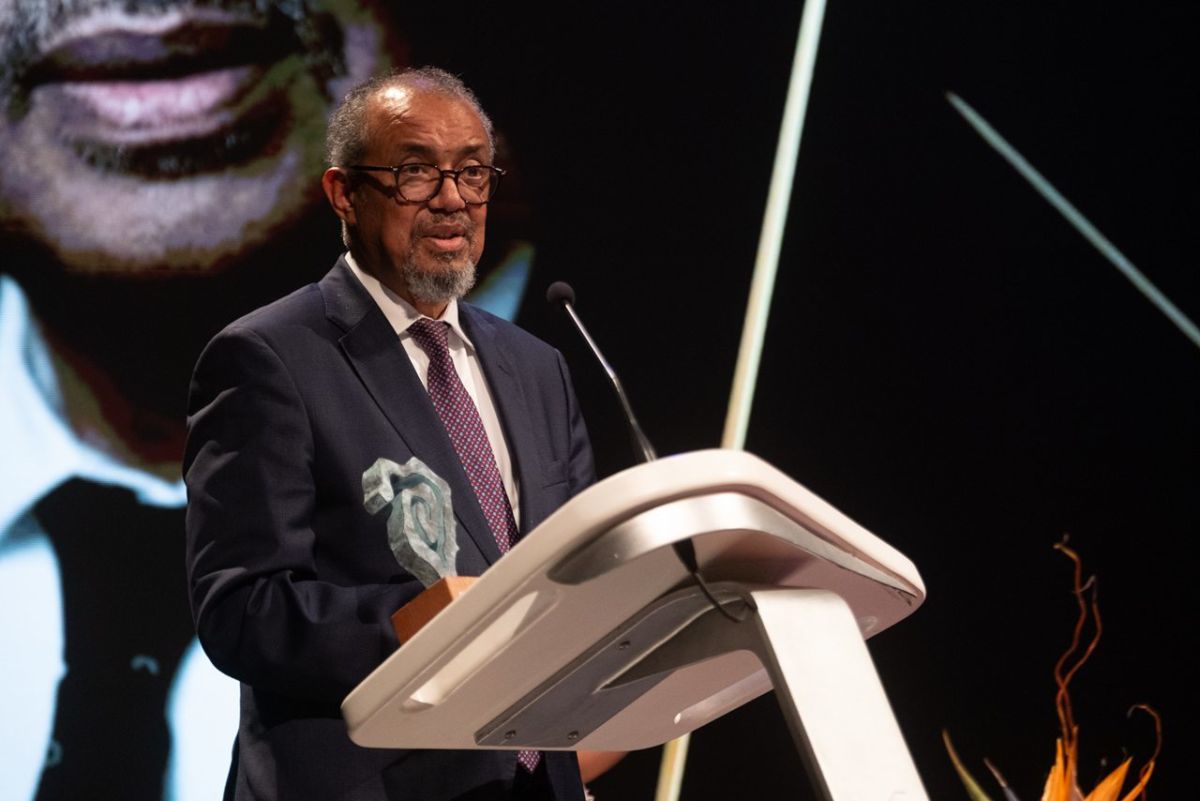
The Director-General of the World Health Organisation (WHO), Tedros Adhanom Ghebreyesus, delivered an emotional tribute to the people of Tenerife during the eleventh edition of the Taburiente Awards, turning the presentation of the International Award for Harmony into a powerful message about solidarity, humanity and collective responsibility.
Speaking at the awards ceremony, Tedros made it clear that he did not consider the distinction a personal achievement. Instead, he dedicated it to the island and its people, whose response to an international health emergency had demonstrated, in his words, the importance of placing compassion above fear.
“I owe this award to the people of Tenerife,” he declared.
The WHO Director-General recalled the events of last May, when an outbreak of hantavirus aboard the MV Hondius led the vessel’s crew to seek assistance from the Spanish and Canarian authorities.
The ship needed a safe port where its passengers could receive medical care, placing Tenerife at the centre of a situation involving health concerns, uncertainty and difficult decisions. Tedros acknowledged that the island’s response had not been without challenges, particularly given the understandable concerns about the possible spread of infection.
Nevertheless, he praised the way the community responded, describing it as an example of humanity prevailing in the face of fear and division. His address was one of the most moving moments of an evening that also featured a reflection on global instability from Josep Borrell, the former High Representative of the European Union for Foreign Affairs and Security Policy.
Borrell warned that the increasing number of armed conflicts around the world demonstrated how fragile peace had become, urging European societies to protect the freedoms, institutions and democratic principles that allow people to live together.
Tedros dedicates his award to the people of Tenerife
Tedros Adhanom Ghebreyesus used his acceptance speech to recognise the solidarity shown by Tenerife during the health emergency involving the MV Hondius. The WHO Director-General recalled the difficult circumstances surrounding the vessel’s request for assistance, with passengers who were ill, frightened and far from their homes.
For those on board, finding a safe port where they could receive appropriate medical attention was essential. For the authorities and residents of Tenerife, however, the situation also raised concerns about the possible public health consequences of receiving a ship affected by an infectious disease outbreak.
Tedros did not dismiss those concerns. Instead, he acknowledged that fear in such circumstances is a natural and understandable reaction, particularly when people are confronted with an unfamiliar health threat. “Many of you were concerned. You wondered whether the virus might spread and whether your island was being exposed to a risk it should not have to bear,” he recalled.
His words recognised the uncertainty experienced by the island’s population and the difficult balance between protecting public health and providing assistance to people in need. For Tedros, the defining aspect of Tenerife’s response was not the absence of fear, but the willingness to act with compassion despite that fear.
“Feeling fear in the face of an epidemic outbreak is not selfishness. It is human. What matters is how we act afterwards. And what you did was extraordinary.” The WHO Director-General emphasised that extraordinary situations often reveal the values that guide a society.
In the case of Tenerife, he said, the community had demonstrated that concerns about safety and a commitment to helping others need not be mutually exclusive. The response to the MV Hondius emergency had shown, in his view, that solidarity could prevail even when circumstances were complex and potentially risky.
“Here, in Tenerife, I witnessed an alternative”

Drawing on his experience leading the World Health Organisation, Tedros reflected on the consequences that fear and social division can have during public health emergencies. Throughout his career, he has witnessed how the emergence of infectious diseases can create uncertainty, mistrust and tension within communities.
In some circumstances, fear of contagion can lead to exclusion, hostility or reluctance to assist those affected by an outbreak. Such reactions, he suggested, can make an already difficult situation even more challenging. Against that background, Tedros presented Tenerife’s response as an example of a different approach.
“Over many years I have seen what fear and division can lead to during an emergency. Here, in Tenerife, I witnessed an alternative,” he said. The statement encapsulated his appreciation for the way the island had responded to the request for assistance. Rather than focusing solely on the potential risks, he highlighted the ability of the authorities and the community to recognise the humanitarian needs of those on board.
His remarks also reflected a broader principle of international public health: that effective responses to emergencies depend not only on medical resources and scientific expertise, but also on trust, cooperation and the willingness to support others.
The experience of the MV Hondius, he suggested, offered a reminder that compassion remains essential when societies are confronted with uncertainty.
“Solidarity is our best immunity”
The defining moment of Tedros’s speech came when he condensed his message into a phrase that captured both the significance of the International Award for Harmony and the spirit of his tribute to Tenerife.
“Solidarity is our best immunity.”
The WHO Director-General’s words emphasised the importance of cooperation and mutual responsibility in confronting health emergencies. His message went beyond the circumstances of the MV Hondius incident, highlighting a principle that applies to public health challenges around the world.
In a globalised society, infectious diseases and health emergencies can affect communities far beyond the places where they first emerge. Responding effectively requires coordination between authorities, health professionals, institutions and populations, as well as a willingness to assist those facing difficult circumstances.
For Tedros, Tenerife had provided a meaningful example of how these values could be put into practice. By dedicating his award to the people of the island, he placed their response to the emergency at the centre of the recognition he had received.
The distinction, he insisted, belonged to a society that had demonstrated its ability to act with humanity when confronted with a difficult decision. His speech concluded with a simple expression of gratitude directed at the community whose solidarity he had come to recognise.
“Thank you, Tenerife. Thank you very much!”
The closing words brought an emotional end to an address that celebrated not only the island’s response to a particular emergency, but also the broader importance of compassion and international cooperation.
Josep Borrell warns of a world increasingly marked by conflict
Another of the evening’s most significant speeches was delivered by Josep Borrell, the former head of European diplomacy. After receiving his Taburiente Award, Borrell reflected on the growing instability of the international order and the responsibilities facing Europe at a time of demographic change, political division and armed conflict.
Drawing on his extensive diplomatic and political experience, including his time as President of the European Parliament and the EU’s High Representative for Foreign Affairs and Security Policy, he argued that Europeans should recognise how fortunate they are to live in societies characterised by relative peace, freedom and prosperity.
However, he also warned that these achievements cannot be taken for granted. His speech addressed Europe’s declining share of the world’s population, the challenges associated with an ageing society and the pressures created by international instability.
Borrell placed particular emphasis on the need to preserve peaceful coexistence and strengthen the institutions that protect democratic societies.
Europe: prosperous but increasingly vulnerable

Borrell began by reflecting on Europe’s privileged position in the world, describing it as a region that enjoys extraordinary levels of freedom and prosperity compared with many other parts of the globe. At the same time, he argued that demographic changes are placing the continent in a particularly complex situation.
According to the figures he cited, Europeans currently account for approximately five per cent of the world’s population, compared with around 25 per cent in the aftermath of the Second World War. He pointed to this decline as evidence of Europe’s changing place in the international order.
The continent, he explained, is becoming both smaller in demographic terms and older, creating challenges for its long-term future. “We are becoming fewer in number and older, which places us in a special position—one that is both vulnerable and responsible,” he observed.
Borrell emphasised that Europe remains among the richest and most prosperous parts of the world, a position that entails responsibilities towards people living under considerably more difficult circumstances. In his view, prosperity should be accompanied by a commitment to others.
However, he also warned that Europe’s ageing population and demographic decline make it increasingly vulnerable. He linked these concerns to migration, referring to the people who attempt to reach European shores in search of opportunities and living conditions that are unavailable in their countries of origin.
For Borrell, the future of Europe cannot be separated from these demographic and humanitarian realities. His remarks presented migration not simply as a political challenge, but as an issue connected to the continent’s longer-term development and its responsibilities towards the wider world.
“War is returning to our borders”
The former EU foreign policy chief then turned to the conflicts he had witnessed during his diplomatic career. Borrell recalled his experiences in Ukraine and the Middle East, describing how direct exposure to war and human suffering had profoundly influenced his understanding of international relations.
“I have seen the trenches in Ukraine and what is happening in the Middle East at close quarters,” he said. These experiences, he acknowledged, had left him with a degree of pessimism about humanity’s capacity to inflict suffering on others. He described this as a form of anthropological pessimism, rooted in witnessing the consequences of armed conflict.
The return of war to Europe’s borders, he argued, has challenged the assumption that peace had become a permanent feature of the continent’s political and social life. For decades, many Europeans had come to regard peace as the natural state of affairs, particularly following the devastation of the Second World War and the subsequent process of European integration.
Recent events, however, have demonstrated that this stability cannot be regarded as guaranteed. “We thought peace was the natural state of affairs and that we had returned to it, but the reality is that the world is increasingly in conflict,” Borrell warned. He referred to 56 active wars worldwide, describing the number as evidence of the scale of contemporary instability.
According to Borrell, the persistence and spread of armed conflict demonstrate that violence remains a central challenge for international society.
“Today, the natural state is violence and conflict,” he stated.
His comments reflected a concern that the institutions and political arrangements responsible for maintaining peace are facing growing pressures.
The importance of the rule of law and democratic institutions

Against this increasingly unstable international background, Borrell argued that peace requires strong institutions and societies governed by clear rules. In his view, the rule of law plays an essential role in preventing violence and allowing disputes to be resolved without resorting to armed confrontation.
“To curb violence and conflict, we need the rule of law and more organised societies,” he said. He pointed to Europe as an example of the benefits that such structures can provide. Despite its internal challenges, the continent continues to offer high levels of freedom, security and prosperity.
“Nowhere else in the world are people freer, or do they live in such peace and prosperity as in Europe,” Borrell maintained. His remarks were also a warning against complacency. The freedoms enjoyed by European societies, he suggested, are the product of political decisions, institutions and collective efforts that must be continuously defended.
In a world where violence, displacement and instability remain widespread, preserving these achievements is a shared responsibility. For Borrell, the challenge is not merely to maintain Europe’s prosperity, but also to protect the democratic principles and social cohesion that make peaceful coexistence possible.
“When you travel the world, you see the open wound that is humanity”
Drawing on his years of international diplomatic experience, Borrell described the profound impact of witnessing conflict and suffering in different parts of the world. “When you travel the world, you see the open wound that is humanity,” he reflected. The image conveyed his concern about the human consequences of war, political instability and division.
It also served as a reminder of the importance of recognising and protecting the achievements of European societies. For Borrell, the ability to live together peacefully remains one of the most valuable accomplishments of democratic communities. He therefore urged Europeans to make a conscious effort not to lose sight of what they have.
This includes the freedoms, institutions and social arrangements that allow people with different perspectives and backgrounds to coexist. He warned that political disagreements should not be allowed to undermine the broader principles on which democratic life depends.
The former EU foreign policy chief concluded by calling for a form of democracy capable of managing differences without allowing them to become permanent divisions. “Let us make that effort so that democracy is not synonymous with division, but with thinking about the future and deciding on it in peace.”
His closing appeal placed peaceful coexistence at the centre of Europe’s responsibility for its own future.
Two messages united by solidarity and responsibility
Although Tedros Adhanom Ghebreyesus and Josep Borrell addressed different challenges, their speeches at the Taburiente Awards shared a common concern: the importance of collective responsibility in a world increasingly marked by uncertainty.
Tedros focused on the human response to public health emergencies, praising Tenerife for demonstrating that compassion and cooperation can prevail over fear. Borrell, meanwhile, reflected on the fragility of international peace and the need to defend the democratic institutions that allow societies to resolve their differences without violence.
Both speakers highlighted the consequences of division and the value of working together when faced with difficult circumstances. For the WHO Director-General, Tenerife’s response to the MV Hondius emergency showed how solidarity can guide communities through moments of uncertainty.
For the former EU foreign policy chief, Europe’s experience demonstrated that peace and prosperity require constant effort, political responsibility and a commitment to coexistence. Their messages reinforced the broader purpose of the Taburiente Awards: to recognise individuals whose work and convictions contribute to a more humane, responsible and cooperative society.
The evening’s speeches ultimately served as a reminder that solidarity, whether expressed through humanitarian assistance or through the defence of peace and democratic values, remains essential in confronting the challenges of the modern world.