




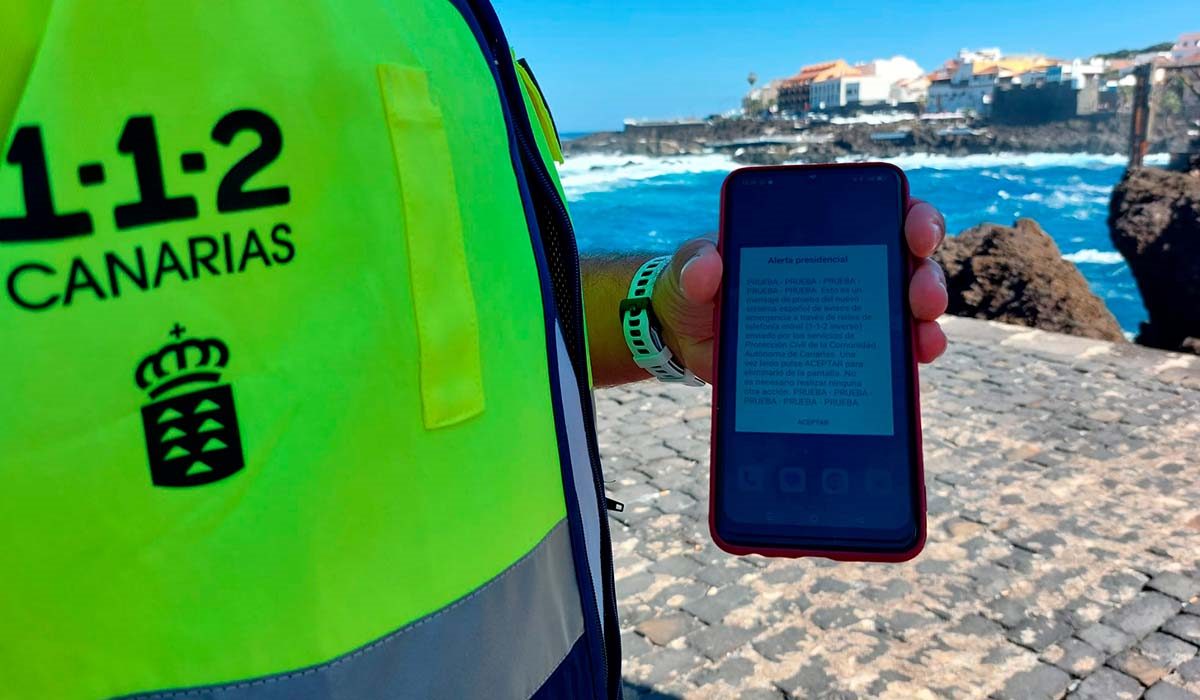
Mobile phones across Tenerife will receive a series of simulated emergency alerts next Thursday, 22 October, as part of a major volcanic risk exercise organised on the island. The Government of the Canary Islands will send three ES-Alert notifications between 9.00 am and 2.00 pm during the VOLCANEX Tenerife 2026 drill, which will take place in Guía de Isora.
The messages will be issued by the Directorate-General for Emergencies through the Emergency and Security Coordination Centre, CECOES 112. Each notification will be accompanied by a loud warning sound and vibration, even on phones set to silent mode.
Authorities have stressed that the operation is only a drill. There is no real volcanic emergency and no general evacuation, confinement or lockdown measures will apply to the public. Because the system uses mobile phone masts to transmit the alerts, some people outside the main target areas may also receive the notifications.
Three alerts will be sent between 9.00 am and 2.00 pm
112 Canarias plans to issue three different ES-Alert messages over the course of the exercise. Each one will contain different information and will target a different geographical area. The first alert will be sent across the whole of Tenerife.
It will notify recipients of a simulated change in the island’s volcanic alert level to orange under PEVOLCA, the Special Plan for Civil Protection and Emergency Response to Volcanic Risk. An orange alert in this exercise does not mean that an eruption has begun.
Nor does the simulated change in alert level trigger any real evacuation or confinement measures for the population.

Due to the reach of mobile phone antennas, the message could also be received in some areas of Gran Canaria, La Palma, La Gomera and El Hierro, as well as by people travelling through maritime corridors between the islands.
Simulated evacuation of Chirche and Aripe
The second ES-Alert will mainly target the municipalities of Guía de Isora and Santiago del Teide. This message will announce a simulated precautionary evacuation affecting only the villages of Chirche and Aripe.
The measure forms part of the exercise and does not apply to the general population. Because of the technical coverage of the mobile network, however, the alert may also appear on phones located in nearby areas, including Adeje, Los Silos, Buenavista del Norte and El Tanque.
Some users on the western islands may also receive the notification. Authorities have underlined that receiving a message outside the intended area does not mean that the municipality or locality concerned is subject to the measures described in the alert.
The third and final message will inform recipients that the volcanic emergency exercise has ended.
What should you do if your phone receives the alert?
Members of the public do not need to reply to the notification or contact 112. The messages will clearly state that they form part of a drill and will appear directly on compatible mobile phones.
Emergency services recommend remaining calm when the warning tone sounds and reading the message carefully before selecting “Accept” to close it. Anyone who is driving when the alert arrives should stop in a safe place before checking the notification.
Authorities also recommend explaining the exercise in advance to elderly relatives or other people who may be unfamiliar with the ES-Alert system, in order to prevent unnecessary concern.

The instructions contained in the messages should always be interpreted within the context of the scheduled exercise. Phones that are switched off or set to aeroplane mode will not receive the alert while they remain in those states.
A device that enters an affected coverage area while an alert is still active may receive the notification at that point. If the phone is configured in a language other than Spanish, the message may appear in English.
What is ES-Alert?
ES-Alert is a public warning system that allows Civil Protection authorities to send emergency notifications to mobile phones located within a specific geographical area. The system uses cell broadcast technology, meaning users do not need to download an application, create an account or register their phone number.
According to official information from 112 Canarias, reception of these alerts is enabled by default on Android devices running version 11 or later and on iPhones using iOS 15.6 or later.
The system can be used during serious emergencies including forest fires, floods, volcanic eruptions and severe weather events. Its purpose is to rapidly reach large numbers of people in a defined area and provide instructions or safety information during an emergency.
VOLCANEX Tenerife 2026 volcanic drill
The alerts form part of VOLCANEX Tenerife 2026, an exercise designed to test how authorities and emergency services would respond to a possible volcanic eruption on Tenerife.
The drill is being organised by the Tenerife Island Council in Guía de Isora. As part of the exercise, the Island Council plans to carry out preventive evacuation simulations in Chirche and Aripe. The operation will also include scenarios involving elderly residents, people with reduced mobility, tourists and animals.

Emergency planners will test arrangements for receiving and accommodating evacuees, protecting essential infrastructure and coordinating the different emergency services and public authorities involved.
The exercise is centred on the Las Cumbres de Abeque area, within the Santiago del Teide-Guía de Isora sector. This area is classified as posing a very high volcanic threat within Tenerife’s contingency planning.
President of the Tenerife Island Council Rosa Dávila has said that the main objective of the exercise is to strengthen the island’s preparedness for a real volcanic emergency.
The use of ES-Alert during the drill will also allow emergency authorities to test the functioning and geographical reach of the warning system while helping residents become more familiar with the type of notification they could receive during a real crisis.
The system has already been used during actual emergency situations in the Canary Islands. For most residents, the most noticeable part of the exercise on 22 October will therefore be the sudden alarm sound on their mobile phones.
Authorities stress that the messages are simulated, that no general protective measures are required, and that people should simply read the notification and follow the information provided as part of the drill.

